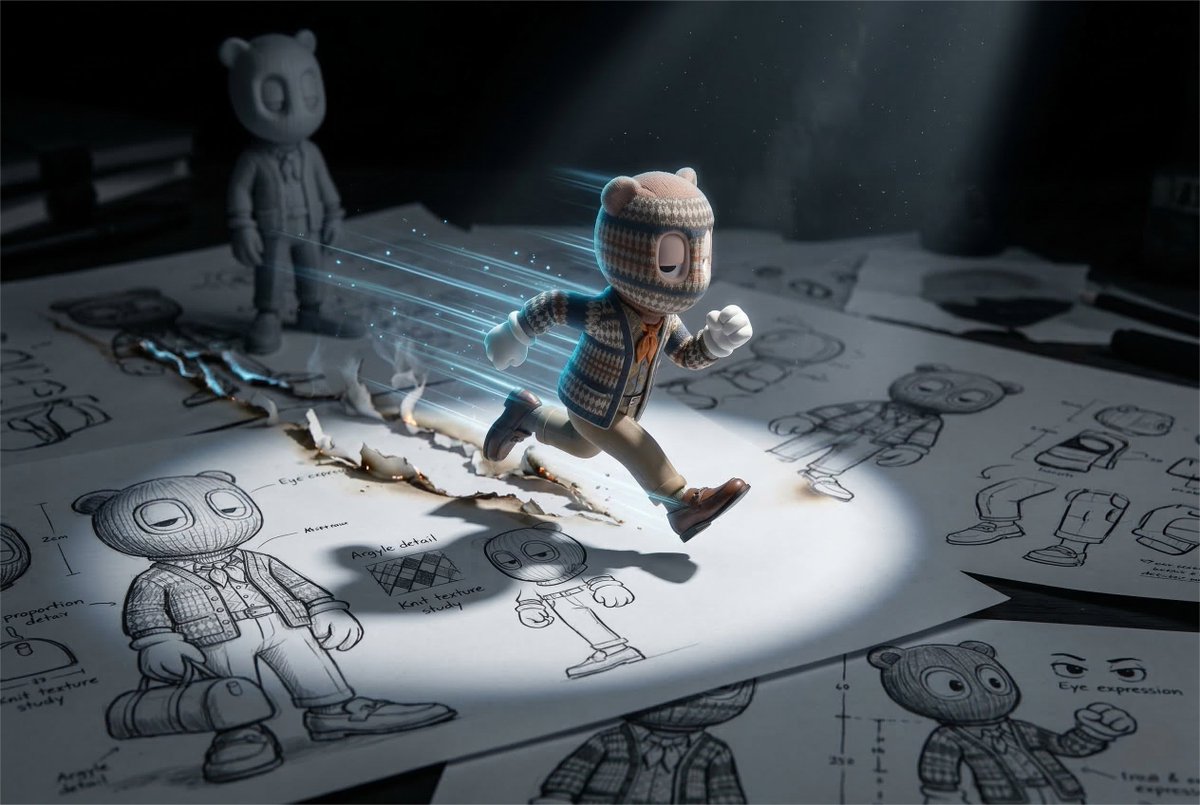
Nano Banana Pro AI image example generated with this reusable CDance AI prompt: A highly detailed prompt for generating a cinematic macro toy-photography scene using Nano Banana 2, depicting a bean-sized character from…
Cinematic Macro Toy Photography of a Sprinting Character
A highly detailed prompt for generating a cinematic macro toy-photography scene using Nano Banana 2, depicting a bean-sized character from an uploaded reference image sprinting explosively across character design pages, emphasizing exact likeness preservation and dynamic action effects.
BY @Edizkan ⭕🦇
Prompt
A cinematic macro toy-photography scene. A bean-sized version of the uploaded reference character is sprinting explosively captured at the peak stride moment of a high-speed sprint with visual effect. Character Pose: A dynamic, mid-sprint action pose with amazing visual effects captured from a three-quarter side profile. Torso: Leaning forward at a sharp angle to convey momentum. Arms: One arm is bent sharply at the elbow with the fist tucked near the chest; the other arm is extended backward, trailing behind the torso. Legs: In a full stride. The lead leg is bent forward with the knee high, while the trailing leg is fully extended back with the foot pointed. Head: Facing forward, aligned with the direction of the run. The character runs across the surface of several giant black-and-white character design pages fully covering the ground, featuring the same character. Likeness Preservation (CRITICAL): The identity of the character must remain exactly identical to the reference in both: • the miniature physical character • the character shown in the design sketches. The sketch pages must show the same character, including: • dynamic poses small sketches • head studies and shape explorations • proportion notes • accessory sketches • construction diagrams • small handwritten annotations. Maintain the exact: • head shape • eye shape and spacing • stylization • silhouette • materials and clothing design. If the character wears a balaclava, mask, helmet, or covered face, the sketches must not invent facial anatomy. No added nose. No added mouth. No visible skin where the reference does not show it. Do not humanize the character. Do not reinterpret anatomy. Subject & Action: The miniature character sprints explosively across the design pages, tearing through the sketch sheet as it runs. The character is captured at the peak stride moment of a full-speed sprint. Running pose details: • the body leans sharply forward as if accelerating • one leg is fully extended forward while the other drives powerfully backward • arms pump in opposite running motion • the torso twists slightly creating a dynamic curved spine line • the pose feels like a high-speed comic-book sprint. The character’s momentum rips through the paper, creating a jagged torn path behind it. A trail of torn paper curls and fragments with vfx follows behind the running character as if it burst out of its own design. Oversized design sheets surround the character, each page showing different stages of development of the same character. One small grey 3d print of the character is in the background as an exact copy of the uploaded image. Camera & Perspective: Captured from a medium camera distance above the desk, allowing a wider portion of the surrounding design pages to be visible. Shot with an 85mm macro lens, creating natural compression while keeping the environment readable. The camera sits slightly elevated and angled downward toward the running character. The character remains the focal point but occupies roughly one third of the frame, revealing more of the design sheets and workspace around it. The character remains slightly off-center within the spotlight. Depth of Field: Extremely shallow depth of field. The sprinting miniature character and the immediate section of the torn sketch page are razor sharp. Surrounding pages and distant elements fall into soft blur. Lighting (VERY DRAMATIC): A single narrow spotlight / flashlight beam hits the character. The beam comes from a side-front direction, creating a bright circular pool of light on the design page. Lighting characteristics: • extremely hard light • very high contrast • no ambient fill light • the surrounding elements fades into near-total darkness • sharp dramatic shadows stretch across the paper • edges of the light beam fall rapidly into black. The environment outside the spotlight should feel almost completely swallowed by darkness, as if the character has been suddenly caught under a stage light. Dust particles float through the beam. Environment & Surface Detail: Macro-level detail of the design pages: • ink texture • pencil strokes • paper fibers • subtle reflections on graphite lines. The torn paper edge reveals fibrous paper layers and curled fragments along the ripped path. Subtle Heat Burn Detail: Along parts of the torn path, the paper shows light scorching caused by extreme speed friction: • edges of some tears are slightly darkened and singed • faint burnt browning transitions into the white paper fibers • tiny ember-like glowing specks appear briefly along the freshest tear points • very subtle wisps of heat distortion or smoke rise from a few edges. The burn effect must remain minimal, believable, and physically grounded, enhancing realism without turning into flames or overpowering the scene. Color Grade: Desaturated sketch pages and environment. The character receives cool cinematic highlights from the spotlight. Moody macro photography atmosphere. Rendering Style: Photorealistic macro toy photography, emphasizing scale illusion between the tiny character and the giant design pages. Speed Energy VFX: A stylized high-speed energy trail follows behind the running character, emphasizing the explosive sprint. The trail consists of thin luminous motion streaks and glowing particles streaming backward from the character’s movement direction. Characteristics: • energy streaks originate from behind the character’s shoulders, arms, and legs • streaks extend diagonally backward, following the direction of motion • the lines are semi-transparent glowing blue light trails • small sparkling particles scatter along the trail • the effect should feel like comic-book speed energy, not smoke or fire • the VFX enhances motion but does not cover or obscure the character. The light streaks interact subtly with the environment: • faint glow reflecting on the torn paper edges • slight blue rim light on the character’s silhouette • a few glowing particles floating through the spotlight beam. The energy trail should feel fast, sharp, and directional, reinforcing the sense that the character is sprinting at extreme speed. ar 3:2
Related Nano Banana Pro Prompts
Wide quote card with portrait and Chinese/English customization
A prompt for generating a wide quote card featuring a famous person’s portrait, with a brown background, light-gold serif quote text, and layout where text occupies two-thirds and the person one-third. The quote text and author are parameterized for reuse.
Premium liquid glass Bento grid product infographic with 8 modules
Create an Infographics with bento grid 8 module layout, user can specify any product name in Food, Medicine, tech etc category, choose language, Background style, Hero grid style
Hand-drawn style header image prompt from photo
Prompt for a hand-drawn style header image of a person introducing Nano Banana Pro
Watercolor map of Germany with labeled states
A German prompt to generate a watercolor-style map of Germany where all federal states are labeled in ballpoint pen, useful for educational or infographic-style maps.
New Year's Day Special: Four-Panel Puzzle for 2026 Blessing
A detailed multi-panel prompt for Nano Banana Pro, creating a 2x2 grid photo collage where a single female character, in four different outfits and settings, pieces together a puzzle that spells '2026 New Year's Day Happy' in the center. The prompt specifies precise facial feature retention, clothing details, background elements, and photographic parameters for a fashion magazine style.
Vintage Patent Document for an Invention
A prompt designed to generate an image of a vintage United States patent document from the late 1800s. It specifies details like precise technical drawings, handwritten annotations, aged paper texture, foxing stains, an embossed seal, and a wax stamp, making it ideal for historical or archival aesthetics.