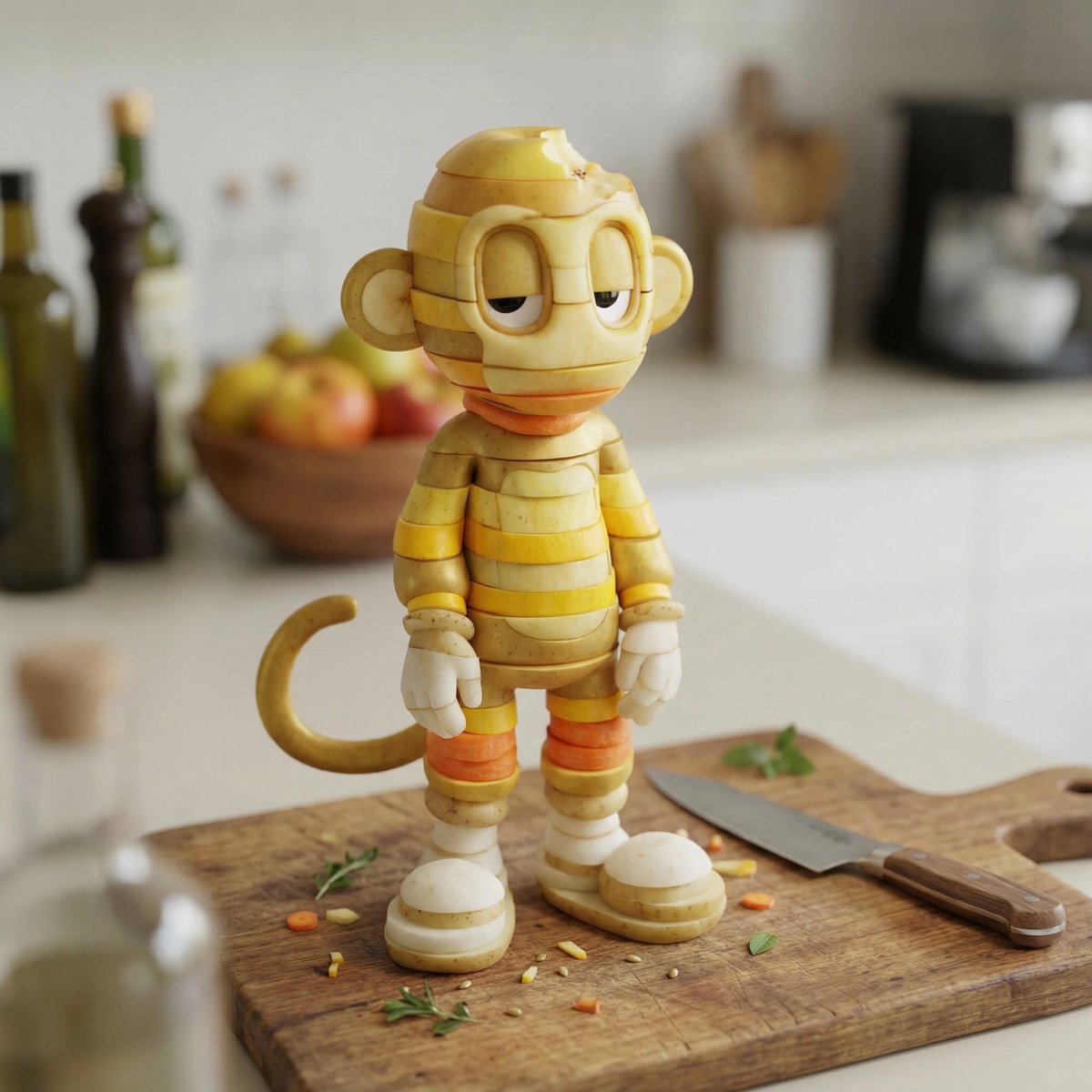
Nano Banana Pro AI image example generated with this reusable CDance AI prompt: A detailed prompt for Nano Banana Pro designed to convert an uploaded character reference into a realistic 3D render made entirely of…
Character Rebuilt from Sliced Fruits and Vegetables
A detailed prompt for Nano Banana Pro designed to convert an uploaded character reference into a realistic 3D render made entirely of layered, sliced fruits and vegetables, maintaining the original character's proportions, colors, and identity while ensuring all materials, including footwear, are constructed from produce slices.
BY @Edizkan ⭕🦇
Prompt
create a version of this character made entirely of sliced vegetables and fruits vegetables and fruits: should match the uploaded character’s colors as closely as possible, without changing their natural look slices: slightly misaligned, with visible separation between layers structure: a small bite taken out of the top of the head, forming a clean cut surface ambience: kitchen setting, on a cutting board with scattered vegetables and a knife nearby camera: slightly top-down angle effect: tilt-shift Likeness Preservation (CRITICAL): Maintain exact proportions, eye shape, spacing, stylization, silhouette, and material identity from the reference Do not humanize Do not reinterpret anatomy Do not modify facial structure Identity must remain perfectly intact and instantly recognizable Character Compatibility Rules: If the uploaded character is 2D, convert it into a believable realistic 3D render while preserving the original design, proportions, colors, and visual identity Do not modify facial structure Do not add a mouth or nose if the uploaded character does not have them 👟 FOOTWEAR & ACCESSORY MATERIAL OVERRIDE (CRITICAL FIX) All parts of the character, including footwear and clothing, must follow the same fruit and vegetable slice construction. • shoes must be made entirely of stacked fruit and vegetable slices • preserve the exact shoe shape, proportions, and design • recreate panels, sole, and details using layered slices Material examples for shoes: • sole → dense stacked potato or root vegetable slices • upper panels → fruit/vegetable slices arranged to match original color blocking • edges and seams → visible slice layering and separation 📷⚠️ 0px; letter-spacing: normal; orphans: 2; text-indent: 0px; text-transform: none; widows: 2; word-spacing: 0px; -webkit-text-stroke-width: 0px;"> IMPORTANT: No original materials should remain (no fabric, rubber, or leather). Everything must be converted into fruit/vegetable slice construction while keeping the original design recognizable. ar 1:1
Related Nano Banana Pro Prompts
Wide quote card with portrait and Chinese/English customization
A prompt for generating a wide quote card featuring a famous person’s portrait, with a brown background, light-gold serif quote text, and layout where text occupies two-thirds and the person one-third. The quote text and author are parameterized for reuse.
Premium liquid glass Bento grid product infographic with 8 modules
Create an Infographics with bento grid 8 module layout, user can specify any product name in Food, Medicine, tech etc category, choose language, Background style, Hero grid style
Hand-drawn style header image prompt from photo
Prompt for a hand-drawn style header image of a person introducing Nano Banana Pro
Watercolor map of Germany with labeled states
A German prompt to generate a watercolor-style map of Germany where all federal states are labeled in ballpoint pen, useful for educational or infographic-style maps.
New Year's Day Special: Four-Panel Puzzle for 2026 Blessing
A detailed multi-panel prompt for Nano Banana Pro, creating a 2x2 grid photo collage where a single female character, in four different outfits and settings, pieces together a puzzle that spells '2026 New Year's Day Happy' in the center. The prompt specifies precise facial feature retention, clothing details, background elements, and photographic parameters for a fashion magazine style.
Vintage Patent Document for an Invention
A prompt designed to generate an image of a vintage United States patent document from the late 1800s. It specifies details like precise technical drawings, handwritten annotations, aged paper texture, foxing stains, an embossed seal, and a wax stamp, making it ideal for historical or archival aesthetics.